Author's note: This is an excerpt from the current draft of my book, A Field Guide to Otherkin. It's still a work in progress, but it is scheduled for publication in the first half of 2007. I've already contracted it through Immanion Press, who published my first book, Fang and Fur, Blood and Bone: A Primal Guide to Animal Magic (May 2006).
Articles
Browse by Topic
Popular
Recently Tagged
Well, that should get someone's attention. If there is anyone listening.
How do you recognize leadership in a community that is inherently
highly diverse and geographically distributed? Traditional models of
leadership don't seem to map well to the Otherkin community. In large
part, the Otherkin community is composed of highly individualistic people,
many of whom have a distinct dislike for traditional authority figures.
When you combine this with the sheer geographical spread of the
community members, the resulting situation presents serious challenges
to a traditional model of leadership.
"Am I 'Kin?" or some variation of it is a question that is asked quite
frequently on Otherkin lists and boards. The thing is, it can't be
answered. At least by me or anyone else except the person asking the
question. So it is time to turn the question back instead of answering
it. Are you 'Kin?
When we realize that we were once an intelligent being different from humans, we tend to drift away to those distant times when things were simpler and much different. This happens for two reasons: the previous body had a number of advantages over humans, and we simply already know how to live in that other body. Even in the same lifetime, we may have a more localized situation where, in the face of difficulties, we do all kinds of things to escape back to a carefree childhood. So the fierce rejection of the current body is the same thing, but on a slightly different level. Yes, we were once animals and other humanoids and maybe even nature spirits, but that doesn't devalue the life we have now - it enriches it.
It is possible that we may sometimes be able to remember past lives as they were, but it would be foolish to argue with the fact that remembering is done through the brain that we have now. This brain has been developing its own associative map since childhood, and, in most cases, this very map will be used to decode the memories of past lives. From my own lengthy experience, I can summarize that the most reliable memories come in dreams. There, you can see images about which the current brain knows nothing, and then find these items in the Wikipedia and marvel at the fact that such things actually existed. If the objects you are looking for do not appear in the World Encyclopedia, the only thing left to do is to draw them… And it is possible that there is a huge benefit to doing so. After drawing some objects from dreams about past incarnations, one can compare them with the data received in dreams by other otherkin of the same type. Sometimes, a memory is triggered by something you have seen, heard, or read. But there's a good chance that such memories are running through our current associative map. When I practiced conscious dreaming some time ago, I discovered that the associative map is very important because disembodied objects often don't have images of their own, and the brain picks the most appropriate one to understand what it is dealing with.
Religion and the Sha
So...this might take a bit of explaining. My name is Ami and Ami is the name my parents gave me; just not my biological parents.
My usual, gut-level, teeth-grinding reaction to certain referential allusions that occasionally come up during discussion is as follows:
Reality™ consists of multiple worlds, or as some today say, a "Multiverse of Realities". At a very minimum, Gaelic Traditionalists believe there is a World of the Stars (the Sky), a Middle World (the Earth, or the Land) and an Underworld (the Sea). All of these worlds are connected in some way, with events and magicks from one affecting events occurring in a different world. These Worlds, separated by what some call The Veils, are closer at certain times called the "In-Between Times". It should also be no surprise that the Ancestors practiced Their most important Magicks during such In-Between Times as the sunrise, the sunset, the moonrise, the moonset, and during the transitions of the seasons (Béaltaine and Samhain), as well as the extremes of the Sun (Mid-Winter and Mid-Summer), or the great "Fire Festivals". The period from Samhain to Béaltaine is called "An Ghrian beag" or the "little Sun". The period from Béaltaine to Samhain is called "An Ghrian mór" or the "greater Sun". Great fires are kindled during the fire festivals. The thought behind this is that "like attracts like", so that the Power of the flames will also attract the Magickal Power of the Sun. The fires also encourage and enhance the energies of the Sun and help to create conditions favorable to transmutation of magickal power.
Some of this is from the Torah, some from rabbinical commentary, some from oral tradition, and probably a number of inaccuracies caused by my fuzzy memory on the subject (PLEASE feel free to set me straight if you know this better than me). Please bear in mind that this is not necessarily my take on the whole thing, just the story as I recall it. Here's the gist:
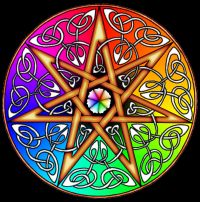
Magpie's essay on the septagram is an incredible one. It was well thought out and researched. However, at her urging I decided to present another view of the septagram... this one intensely personal.
Forget Schoolhouse Rock: three isn't the magic number, seven is. Seven is one of the most widely recognized "lucky numbers", and comes into play with a fair amount of things, both magical and mundane... for example:
Those who would identify themselves as Otherkin or by names that essentially fall within the same description have, very slowly, become increasingly visible. At first, in the 'safe' venue of the online world, but increasingly identifiable in general society; if still quiet and private about their beliefs to most people except one another and the occasional individual who is exceptionally open minded.
Index
In a comment on the parent article Petrael said: "From months of research in the Japanese culture I have never found that the Imperial line of Japan claims descent from Dragons. They claim descent from Amaterasu, the Sun Goddess." The situation is not nearly as simple as it may sound. It's convoluted in the extreme, but I shall do my best insofar as my knowledge. First and foremost, a minor pet peeve of mine; "dragons" and 'long'(Chinese) or 'ryu' (Japan), are not a huge conglomerative lump, regardless of popular regard. Though they sometimes are used to represent some similar Elemental forces (and even this comparison differs widely upon closer examination), they are not the same creature unless you want to say that they are both mythological beings--and one would not attempt I would hope to confuse a Wyvern with a Satyr, or tell one that they are the same thing, if you catch my meaning. 'Western' dragons are by and large potrayed as at least appearing to be almost wholly reptilian, very much in the way that most people have become familiar with them through common fantasy fiction. 'long/ryu' have much more varied appearances and qualities--they can be avian, picine, mammalian, and indeterminate variants between the three. The "Eastern" part of the world that actually claims. most commonly, descent from "long" is actually several of the regional rulers (or Emperors) of ancient China (From which the 'Long' of the Seas are mythologically derived, amongst other things.) As I understand it, Vietnamese mythology also makes a large claim to descent from dragons, but I am much less familiar with that mythos than that of China or Japan. The descent of the Japanese imperial family from 'long'-like beings is convoluted but there is some evidence to support it, at least in an artistic and syncretic sense. The prototypical creator and creatrix of the Ni Hon Go (Rising Sun Land) are Izanami (F) and Izanagi (M). As many of the more 'modern' Japanese beliefs and images are heavily influenced by or derived from Chinese mythology (Shinto basically being a huge multileveled syncretization between Old Religious Taoism and the Aboriginal Ancestor-Worship practices of the original inhabitants of the Island chain, the Ainu--told you it got complicated), many of the older images of Izanami and Izanagi syncretize them with the ancient Chinese images of the progenitors of the universe- Pan Ku (M) and Nu Wa (F)--both of whom were originally portrayed as "Naga"-like beings--that is, serpentine and/or draconian from the waist down. The concept and imagery of the "Naga" comes from the Hindu-Vedic traditions, which has spawned much of the Taoist pantheon and imagery. (Kuan Yin is in fact a female 'aspect' or derivation of the Hindu diety Avalokitesvara [1]--in Japan, she's Kannon, and it pretty much continues in that vein on many fronts.) In the Vedic traditon, there is little to no distinction made between "Naga" and "Dragon/Long", and the words are frequently used interchangeably. In fact, many scholars have postulated that the "Dragon Kings Of The Sea" of China are actually descended from the Vedic mythology of the Naga Kings, and there's a large amount of evidence to support that. (That chunk of mythos, as well as much of that which now supports the belief structure of Feng Shui, appears to have first started appearing in Japan around the Jomon period, but it may well have been earlier, it's hard to say.) What does this all have to do with Amaterasu and Co.? Well, if one postulates that Izanami and Izanagi are derivations of Pan Ku and Nu Wa (which seems likely as much of Japanese mythology is derived similarly) then Izanami and Izanagi would indeed be considered to be of 'draconian' descent, and hence so would their children, among them Amaterasu (From which the Imperial line claims their descent) and Susano (who interestingly enough has many 'draconian' and 'serpentine' associations himself.) The fact that other associations began to be made with Amaterasu later on (most commonly the Phoenix presently due to the fire association, and interestingly enough also derivative of Chinese mythology in which 'dragon' and 'phoenix' represent both opposing and sychronous forces--'yin' and 'yang' if you will, or 'in' and 'yo' in Japanese) would be a fairly recent (at least in terms of mythology and legends) development, and not wholly representative of the original symbology. Additionally, though the Japanese people as a whole may not claim 'descent' from dragons, many of the original 'uji' (clans) of Japan (notably pre "Kojiki" and "Nihongi", both of which are frequently-mangled aggregations of older myths and legends that were highly politicised by the Yamato clan to support their rule) considered many different 'supernatural beings' to be their ancestors, before Shinto as it is commonly percieved today, and multiple individual 'uji' ritual beliefs and practices were aggregated into what it is now. If you look back far enough this information can be found.
Otherkin is a collective noun for an assortment of people who have come to the somewhat unorthodox, and possibly quite bizarre, conclusion that they identify themselves as being something other than human. It is also the label used by a number of communities both on and off line. (The distinction between the two is not always drawn and can lead to some confusion).
Recently I got into a conversation and an interesting topic came up- Is there a difference between weres and therians? I have to admit it threw me off a bit because I had gone through my otherkinity without considering there to be a difference between weres and therians and then two people presented themselves to me adamantly insisting that there was a difference. At first I didn't know what to think of it so I told them that as far as I knew there was no difference but I would look into it. That is exactly what I done and that is what this post is about. Throughout this post I will look at the official definitions of weres and therians, the history of weres/ therians, and people personal stances on the subject. I will eventually come to my own decision and hopefully you can come to one as well.
Most people use "up" for the same general concept, except for particle physicists for whom "up" is a type of quark (but only when discussing subatomic particles, not when taking the elevator - context is often vital). This is not strange (that's a different type of quark) but a fairly usual occurance.
"Soul retrieval" is a concept brought by Sandra Ingerman to Core Shamanism as taught by the Foundation for Shamanic Studies, founded by Michael Harner. For more information, please consult The Way of the Shaman by Michael Harner, Soul Retrieval by Sandra Ingerman and The Foundation for Shamanic Studies.